Trash Chute, Construction Chute, Roofing Chute & Demo Chute Wholesaler
Trash Chute, Construction Chute, Roofing Chute & Demo Chute Wholesaler
OSHA Leading Edge Fall Protection Requirements: A Contractor’s Compliance Guide
Falls from unprotected edges remain one of the leading causes of injury and fatality on construction sites. For general contractors, site supervisors, and safety managers, understanding exactly what OSHA requires — and when — isn’t optional. It’s the difference between a compliant job site and a stop-work order.
This guide breaks down OSHA’s leading edge fall protection requirements in plain terms: what triggers the requirement, what a compliant system looks like, and how to choose between temporary and engineered solutions for your project. Understanding OSHA leading edge fall protection requirements before work begins helps reduce both compliance risk and jobsite hazards.
What OSHA Requires for Edge Protection
Under OSHA 1926.501, employers must provide fall protection whenever employees are working on a walking/working surface with an unprotected side or edge 6 feet or more above a lower level. Guardrail systems are one of three OSHA-recognized methods, alongside safety net systems and personal fall arrest systems — and they’re one of the most common choices for active, moving crews because they provide collective protection without requiring individual harnesses.
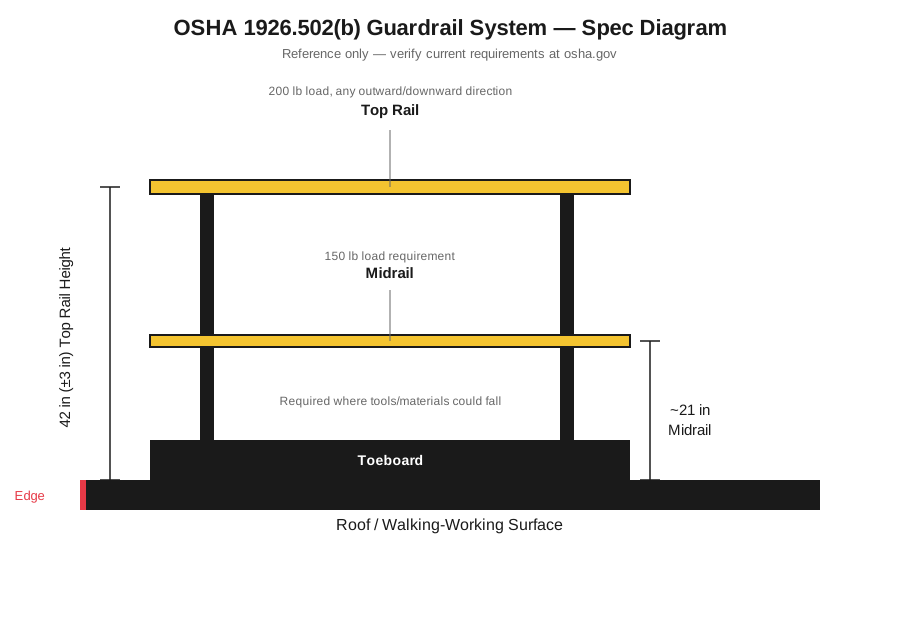
Per OSHA 1926.502(b), a compliant guardrail system must meet these specs:
- Top rail height: 42 inches (±3 inches) above the walking/working surface
- Midrail: installed at approximately 21 inches, halfway between the top rail and the surface
- Toeboard: required where tools or materials could fall to a lower level
- Load resistance: top rail must withstand 200 lbs of force in any outward or downward direction; midrails must withstand 150 lbs
A system that’s missing a midrail, sitting at the wrong height, or built from materials that can’t take the load isn’t compliant — regardless of how it looks on site.
See how HodChutes’ Steel Edge Protection System meets these specs out of the box →
When Is Edge Protection Required on a Job Site?
The 6-foot rule applies broadly, but it’s worth being specific about where it shows up in practice:
- Roof edges and parapets during construction, re-roofing, or maintenance
- Floor and slab openings before permanent guardrails or infill are installed
- Balconies and elevated walkways under active construction
- Scaffolding platforms and loading areas
- Any “leading edge” — the unprotected edge of a floor, roof, or formwork where the permanent structure hasn’t been completed yet
That last category is where most confusion happens, and it’s worth its own section.
Leading-Edge Hazards: Why They’re Treated Differently
A “leading edge” isn’t just any edge — it’s specifically an edge that’s actively changing as construction progresses, like the perimeter of a concrete slab being poured floor by floor, or the open edge of a roof deck before parapet walls go up. OSHA calls these out separately because they carry higher risk: there’s no finished structure yet, crews are moving along the edge as work progresses, and a fixed guardrail installed once may not stay adequate as the job site changes.
For leading-edge work, a fall protection plan generally needs to account for:
- Constantly shifting hazard zones as the slab or roof progresses
- The need for modular, reusable guardrail sections that can move with the work
- Clear documentation of when guardrails are relocated and re-inspected
The Leading Edge Fall Protection Panel is purpose-built for this — modular, reusable, and rated to the same 200 lb load standard →
Temporary Edge Protection: Same Standard, Different Setup
A common misconception is that “temporary” fall protection means a lower compliance bar. It doesn’t. Whether a guardrail is installed for the life of the building or for six weeks during roof work, it has to meet the same 1926.502(b) specifications — same height, same midrail, same load resistance.
What changes with temporary systems is the installation method: non-penetrating counterweighted bases, clamp-mounted posts, or freestanding sections designed to go up and come down without damaging the roof membrane or slab. That flexibility is valuable, but it doesn’t relax the underlying requirement.
The Temporary Roof Edge Protection System is engineered for exactly this — full compliance without roof penetration →
Guardrail Height and Load Requirements at a Glance
Since this comes up constantly on-site, here’s the quick-reference version:
| Requirement | Spec |
|---|---|
| Top rail height | 42 in (±3 in) |
| Midrail height | ~21 in |
| Top rail load | 200 lbs, any outward/downward direction |
| Midrail load | 150 lbs |
| Toeboard | Required when objects could fall to a lower level |
Any roof edge protection guardrail on your site should be checked against this table during pre-use inspection — not just at install.
Common OSHA Leading Edge Fall Protection Mistakes
Most citations and near-misses trace back to a handful of recurring errors, not exotic edge cases:
- Missing midrails. Top rails alone don’t meet 1926.502(b) — the midrail is not optional, even on short runs.
- Incorrect guardrail height. Anything outside the 39–45 inch range (42 in ±3 in) fails inspection, even if it “looks about right.”
- Using damaged rails. Bent, cracked, or corroded sections may no longer meet the 200 lb load requirement, even if they look structurally fine.
- Forgetting re-inspection after relocation. Leading-edge sections that get moved as work progresses need to be re-checked every time — a compliant install on Monday doesn’t guarantee compliance on Friday if it’s been repositioned.
- Assuming temporary systems have different rules. As covered above, temporary and permanent guardrails are held to the identical standard.
Reinforced posts and clamp-mounted options hold up better under repeated relocation than site-built alternatives →
Inspection Requirements: Keeping Systems Compliant Over Time
Meeting the spec at install is only half the requirement — OSHA expects guardrail systems to stay compliant throughout the project, which means:
- Daily visual inspections before crews work near an edge, checking for damage, loosened connections, or drift from the required height.
- Inspection after every relocation. Any time a leading-edge section is moved to follow the work, it needs to be re-checked against the full spec before crews return to that area.
- Immediate removal of damaged components. A bent post or cracked panel gets replaced, not “monitored” for another day.
- Documentation. Keeping a simple log of inspection dates and any corrective action taken protects your project if compliance is ever questioned.
Regular inspections are an essential part of maintaining OSHA leading edge fall protection throughout the project.
Adjustable base systems make daily inspection and repositioning faster on uneven or sloped surfaces →
Real Jobsite Applications
OSHA’s requirements apply the same way across projects, but what compliant edge protection looks like varies by application:
- Roofing projects: Temporary, non-penetrating systems along the roof perimeter that come down cleanly at project completion.
- Multi-story concrete slab construction: Modular leading-edge panels that relocate floor by floor as each slab is poured.
- Balcony construction: Guardrails sized for tighter footprints, often clamp-mounted to avoid penetrating finished surfaces.
- Scaffold edges: Edge protection integrated with the scaffold structure itself, not bolted on as an afterthought.
- Elevator shaft perimeters: Fixed or semi-permanent guardrails around a hazard that persists for the life of the project, not just a single phase.
Post and mounting options for scaffold, parapet, and slab-edge applications →
When Engineered Systems Are Required Over Site-Built Options
Site-built wood guardrails can technically meet OSHA specs, but they come with real drawbacks: inconsistent construction between crews, degradation from weather, and labor time spent building and rebuilding on every project. Engineered steel systems are typically the better choice when:
- The project spans multiple floors or phases, and the same guardrail sections will be reused
- Wind exposure or site conditions make structural consistency critical
- You need guardrails that can be inspected and documented as meeting a fixed, repeatable spec — not “built to code” on a case-by-case basis
- Speed of installation directly affects labor cost and schedule
See the full Steel Edge Protection System lineup — panels, posts, and mounting options engineered to OSHA and EN 13374 standards →
A Note on International Standards
Most of this guide focuses on OSHA because it governs U.S. construction sites. If you’re working on an international project or sourcing equipment that needs to meet both standards, it’s worth knowing that EN 13374 is the European equivalent, covering similar guardrail height and load requirements under a different testing framework. In short: OSHA governs U.S. construction sites, while EN 13374 applies primarily in Europe — the two aren’t interchangeable on paper, but a system built to satisfy both removes the guesswork.
HodChutes’ Steel Edge Protection System is built to meet both OSHA 1926.502(b) and EN 13374 Class A, so the same system works whether your compliance requirement is domestic or international.
Frequently Asked Questions
When is leading edge protection required? Whenever employees work on a walking/working surface with an unprotected edge 6 feet or more above a lower level, and the permanent structure at that edge hasn’t been completed yet — most commonly during slab pours, roof decking, and formwork.
Can wood guardrails meet OSHA requirements? Yes, if built correctly to the same 42 in top rail / 21 in midrail / 200 lb load spec — but consistency across crews and projects is harder to guarantee than with an engineered system, and damaged wood is easy to miss during inspection.
What height must a guardrail be? 42 inches, plus or minus 3 inches, measured from the walking/working surface to the top rail.
Are parapets considered edge protection? A parapet wall can serve as fall protection only if it meets the same height and strength requirements as a guardrail system. Many existing parapets don’t, which is why clamp-mounted guardrail posts are often added on top of them during construction.
Do temporary systems have different requirements than permanent ones? No. Temporary and permanent guardrail systems are held to the identical OSHA 1926.502(b) standard — what differs is the mounting method, not the compliance bar.
Compliance Checklist Before Your Next Inspection
- Top rail at 42 in (±3 in)
- Midrail installed at ~21 in
- Toeboards in place where drop hazards exist
- System rated for 200 lb top rail / 150 lb midrail load
- Leading-edge sections documented and re-inspected after each move
- Temporary installations meet the same spec as permanent ones
- Following OSHA leading edge fall protection requirements from planning through final inspection helps create a safer and more compliant jobsite.
Need a system that checks every box without a custom-quote back-and-forth? Request pricing on HodChutes’ OSHA-compliant edge protection systems today →
This guide is for general informational purposes and does not replace a project-specific fall protection plan or consultation with a qualified safety professional. Always verify current requirements at osha.gov.